Wir haben Ihnen eine E-Mail mit einem Link zum Aktualisieren des Passworts geschickt.
Passwort zurücksetzen
Wir werden Ihnen eine E-Mail zum Zurücksetzen des Passworts schicken.
Is Organic Hair Oil Really Better for Your Hair? Science-Based Answer
My Store Admin
0 Kommentare
-->
Haircare Education7 min read
Is Organic Hair Oil Really Better for Your Hair?
Beyond the premium price tag: what actually changes when you choose a certified organic hair oil over conventional alternatives.
Hair oil is having a moment. Walk into any beauty store and you will see dozens of options — and almost every one claims to be natural or organic. But is genuinely organic hair oil actually better than the conventional alternatives, or is it just a premium price tag? The science says yes, organic is genuinely better — for very specific, measurable reasons. Here is the honest breakdown.
What Goes Into Conventional Hair Oils
Most mass-market hair oils are dominated by mineral oil (a petroleum byproduct), dimethicone or cyclomethicone (silicones), synthetic fragrance, and sometimes a small amount of plant oil added at the end of the ingredient list. The marketing focuses on that small percentage of plant oil while the actual formulation is mostly petroleum and silicone derivatives. This is exactly why reading the first five ingredients matters so much.
These ingredients sit on top of the hair, creating a coating that looks shiny but does not penetrate or nourish. Over time, the buildup can suffocate the scalp, prevent moisture from reaching the hair shaft, and gradually damage hair quality.
What Goes Into Certified Organic Hair Oils
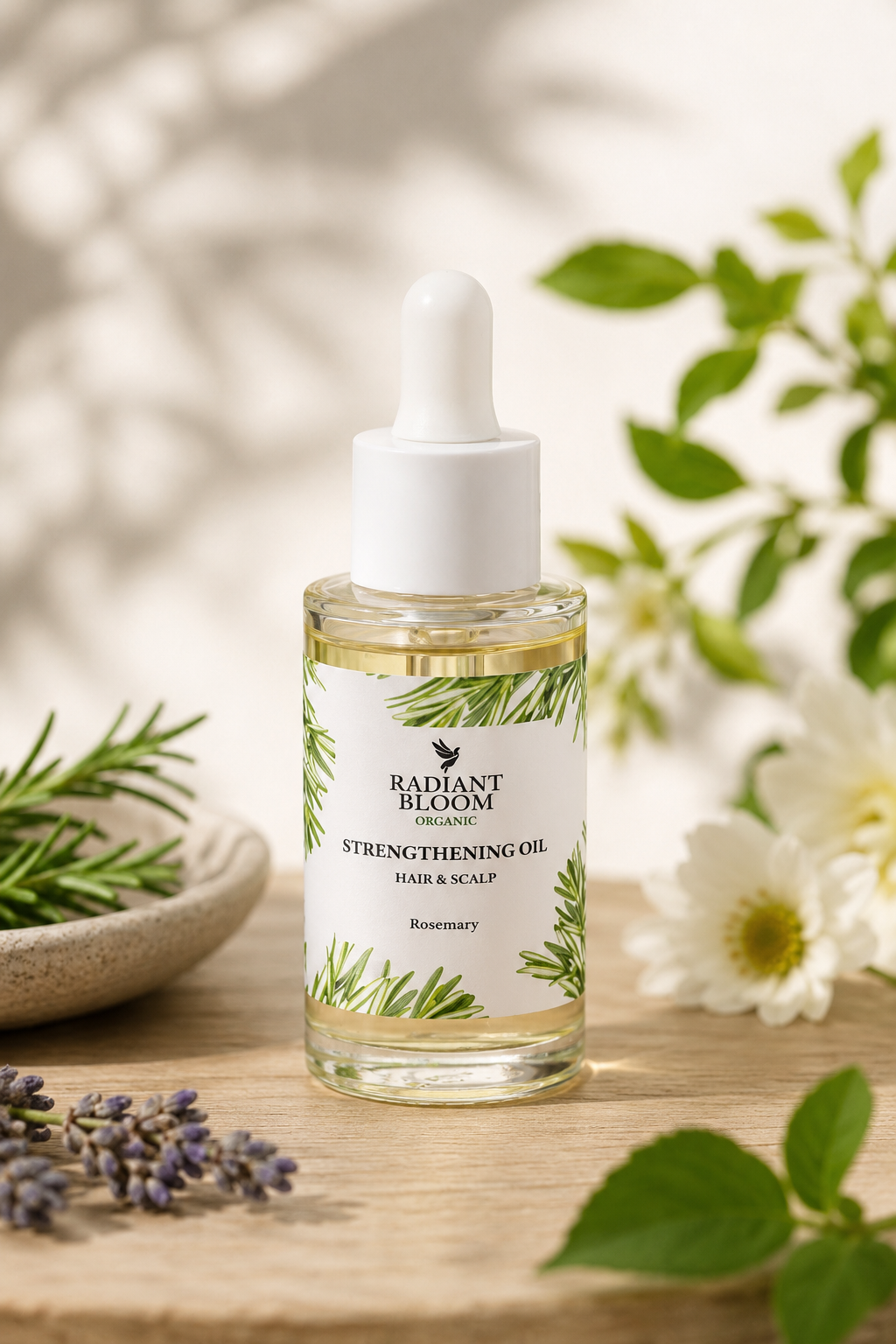
The same cold-press, certified-organic approach drives the ingredient quality across the best organic skincare brands we reviewed in 2025. A true organic hair oil is built around cold-pressed, certified organic plant oils — each chosen for a specific scalp or hair benefit. Premium formulations layer multiple oils to address multiple concerns simultaneously. Our Rosemary Hair & Scalp Strengthening Oil combines eight organic plant oils: rosemary for hair growth, peppermint for circulation, argan and avocado for cuticle repair, almond and olive for nourishment, and hemp and sunflower for shine.
Eight cold-pressed organic plant oils — each chosen for a specific hair or scalp benefit.
1. Nutrient Density Difference
Cold-pressed organic plant oils retain the full nutrient profile of the plants they come from. Rosehip delivers natural Vitamin A and C, jojoba mirrors human sebum, argan delivers Vitamin E and essential fatty acids, and rosemary provides bioactive compounds clinically shown to support hair growth — covered in our breakdown of the rosemary hair growth research. Mineral oil and silicones, by contrast, deliver zero nutrients. They are inert coatings — useful for instant smoothness but offering nothing to underlying hair health.
2. Absorption Difference
Organic plant oils are biologically compatible with human skin and hair structure. They are absorbed at the scalp level, where they can interact with hair follicles and improve scalp health from within. Mineral oils and silicones, being synthetic and chemically unrelated to natural skin lipids, sit on the surface. They do not absorb, do not penetrate, and do not contribute to long-term hair health.
Organic oils are absorbed. Synthetic oils are merely applied. The biology behind that single difference is everything.
3. Long-Term Results Difference
This is where the comparison becomes most stark. Conventional oils deliver instant cosmetic smoothness that wears off as the silicones wash away — leaving hair in its underlying condition (often worse, because the buildup blocked real nourishment). Organic oils deliver gradually compounding results: stronger hair, healthier scalp, denser growth, reduced breakage. After 3 months, the hair using organic oil is measurably healthier. After 6 months, the difference is dramatic. For a deeper comparison, see the full breakdown of organic versus regular hair oil.
4. Safety and Sensitivity Difference
This is one of the central themes of our science-backed organic anti-aging review — what you remove from your routine matters as much as what you add. Synthetic fragrances in conventional hair oils are among the most common causes of scalp sensitivity, contact dermatitis, and persistent itching. Certified organic hair oils either use no fragrance at all or rely on naturally aromatic plant oils. This makes organic oils dramatically safer for sensitive scalps, eczema-prone skin, and those with fragrance allergies.
5. Buildup Difference
Silicones and mineral oils build up on the hair and scalp over time — and they require harsh sulfate shampoos to fully remove. Organic plant oils wash out cleanly with even gentle, sulfate-free shampoos. No buildup means a healthier scalp, clearer hair follicles, and consistently better-looking hair. This is one of the key reasons people commit to the switch from conventional to organic haircare.
Where Conventional Hair Oils Have an Edge
Honesty matters: conventional silicone-based hair oils create an immediate visible shine that organic oils may take a week or two to match. If your priority is one-time event preparation, a conventional oil can deliver fast cosmetic results. For long-term hair health, however, the trade-off is not worth it.
The Bottom Line
Yes, certified organic hair oil is genuinely and measurably better for your hair than conventional alternatives. The key word is certified — uncertified organic claims are unreliable. A real certified organic hair oil delivers nutrition, scalp health, hair growth support, and long-term structural improvement that no silicone-and-mineral-oil formulation can match.